Trading Strategies
The 8 strategies powering the Bayesian fusion engine
Trading Strategies
The fusion engine combines eight independent voters. Each is described below by its mechanics, strengths, known failure modes, recommended timeframe, and — where applicable — its academic evidence base. Live reliability weights are not fixed: they are re-estimated nightly (see Methodology) and reported in each Daily Alpha Brief.
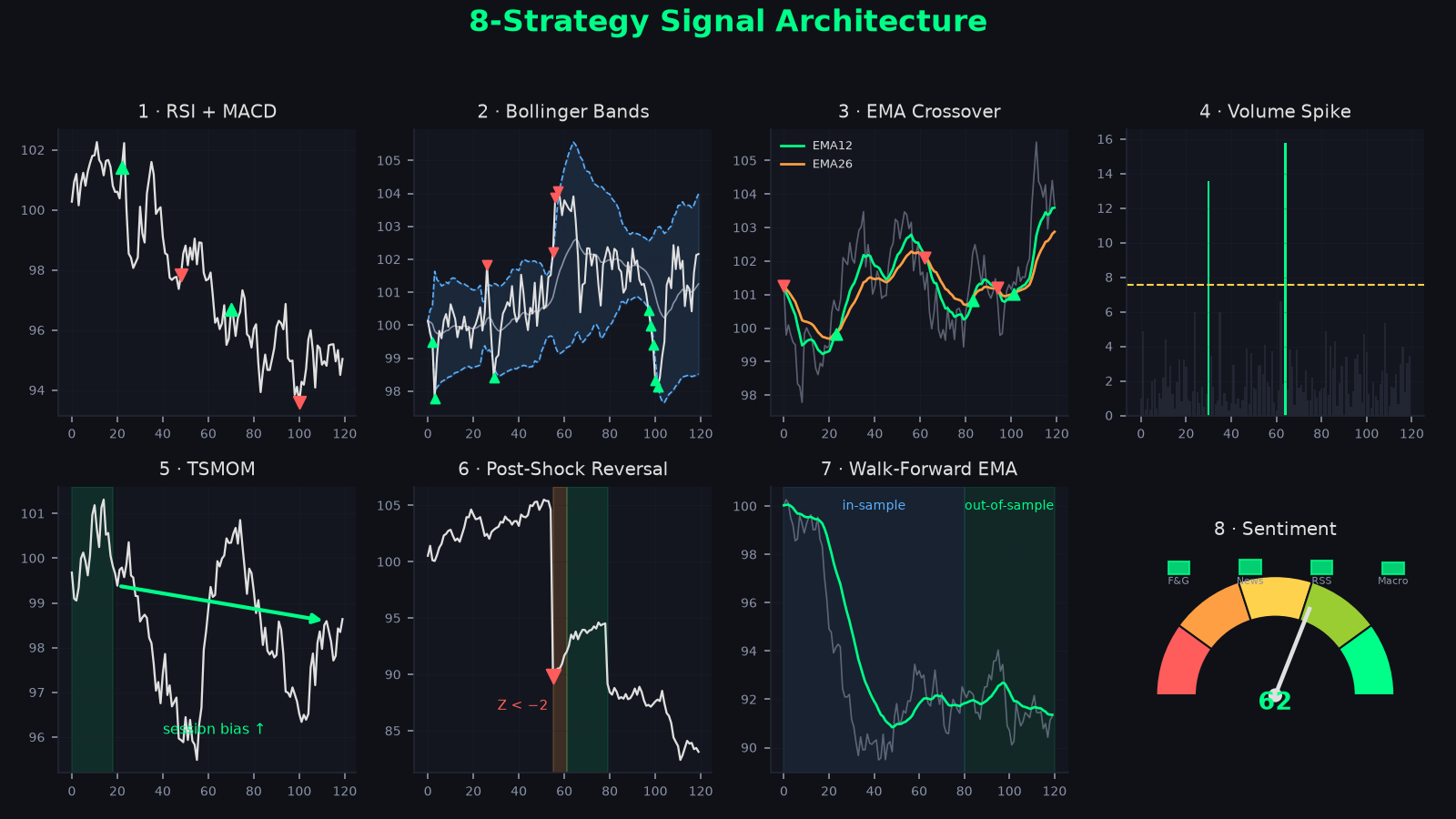 Figure 3: Signal generation logic for all 8 strategies
1. RSI + MACD (Momentum)
Category: Technical — Momentum Timeframe: 5m
Mechanics: The MACD crossover is the trigger and RSI is the filter. BUY when the MACD line crosses above its signal line and RSI < 70 (not yet overbought); SELL when MACD crosses below and RSI > 30 (not yet oversold).
Strengths: Well-validated in trending markets; the dual confirmation rejects many false momentum breaks. High signal frequency on the 5m timeframe provides frequent opportunities.
Failure modes: Whipsaws in ranging markets, where MACD crosses repeatedly with no follow-through. RSI and MACD can diverge — if the filter and trigger never align on the same bar the strategy simply produces no trades.
Known fix: Treat MACD strictly as the crossover trigger and RSI strictly as a gating filter, rather than requiring both to fire as independent signals.
2. Bollinger Bands (Mean Reversion)
Category: Technical — Mean Reversion Timeframe: 5m–1h
Mechanics: Bands are drawn at ±2 standard deviations around a 20-period moving average. BUY when price closes below the lower band (statistically stretched to the downside); SELL when it closes above the upper band. The reversion target is the middle band.
Strengths: Excellent in sideways, range-bound regimes where price oscillates around a stable mean. Naturally adaptive — the bands widen and narrow with volatility.
Failure modes: Dangerous in strong trends, where price can “walk the band” and every reversion entry fights the prevailing move. This is why the reweighting engine down-weights it when ADX signals a strong trend.
3. EMA Crossover (Trend Following)
Category: Technical — Trend Following Timeframe: 1h–4h
Mechanics: A fast EMA crossing above a slow EMA is a BUY (golden cross); the reverse is a SELL (death cross). The strategy holds the directional bias until the next crossover.
Strengths: Simple, robust, and captures the bulk of sustained directional moves. Low parameter count means little to overfit.
Failure modes: Lagging by construction — it enters after a move is underway and exits after it ends. In choppy markets it accumulates a series of small losing crossovers (“chop tax”).
4. Volume Spike (Volume Confirmation)
Category: Technical — Volume Confirmation Timeframe: 1m–5m
Mechanics: Detects bars whose volume exceeds a rolling average by a configured multiple, then votes in the direction of that bar’s price move. The premise: genuine moves are accompanied by participation, and a volume spike marks conviction behind a breakout.
Strengths: Catches the ignition of fast intraday moves that price-only signals miss until later. A useful confirmer for the momentum voters.
Failure modes: Volume spikes also accompany blow-off tops, stop runs, and single-print liquidations — exactly the points where chasing the move is worst. Best used as a confirmation lane rather than a standalone trigger.
5. TSMOM — Intraday Time-Series Momentum (Empirical)
Category: Empirical — Momentum Timeframe: 1h
Mechanics: Uses the sign of recent intraday returns to predict the near-term continuation of the session, scaling the vote by the strength of the move. Based on the documented tendency of crypto sessions to continue in the direction set early in the period.
Strengths: Backed by direct crypto evidence (Shen et al. 2021; Borgards 2021). Momentum windows in crypto are larger than in equity markets, giving the signal more room to work.
Failure modes: Momentum reverses sharply at turning points; like all trend-continuation logic it gives back gains at regime changes. Attributed in the literature to noise-trader behaviour and the absence of a consensus fundamental valuation.
Evidence: Shen, Urquhart & Wang (2021); Borgards (2021). See Research.
6. Post-Shock Mean Reversion (Empirical)
Category: Empirical — Mean Reversion Timeframe: 1h–4h
Mechanics: After a large negative price shock, the strategy expects a partial reversal over the following 6–24 hours and votes BUY. Crucially it is asymmetric — positive shocks do not trigger a symmetric SELL, because the evidence shows reliable reversals only after downside overreaction.
Strengths: Exploits a well-documented overreaction effect; the asymmetry keeps it from fading healthy upside momentum.
Failure modes: A negative shock can be the start of a genuine breakdown rather than an overreaction, in which case the reversion entry catches a falling knife. The effect is strongest under liquidity constraints, which are hard to time.
Evidence: Miralles-Quirós & Miralles-Quirós (2022); Wen et al. (2022). See Research.
7. Walk-Forward EMA with Volatility Targeting (Empirical)
Category: Empirical — Momentum Timeframe: 4h–1d
Mechanics: An EMA trend-follower whose parameters are re-fit on a rolling walk-forward window (to avoid overfitting a single static lookback), with position size scaled inversely to recent volatility (1/σ targeting) so risk per trade is roughly constant across regimes.
Strengths: Volatility targeting limits drawdown when trend strength is high, and walk-forward optimisation guards against curve-fitting. Transaction costs are modelled explicitly, as the source literature insists.
Failure modes: Still a trend-follower at heart — it underperforms in directionless chop, and the walk-forward refit lags structural breaks.
Evidence: Tzouvanas, Kizys & Tsend-Ayush (2020). See Research.
8. Sentiment Strategy (Multi-source)
Category: Sentiment Timeframe: 1h, 4h, 1d
Mechanics: The one voter that does not look at price. It builds a confluence-gated weighted composite from several sentiment lanes — the market Fear & Greed index (0.30), CryptoCompare news (0.30), crypto-native RSS feeds (0.25), and macro/institutional feeds — FT, Fed, CNBC (0.15, market-wide and weighted ×1.5). It votes only when enough lanes agree on direction, so a single noisy source cannot swing it.
Strengths: Adds an orthogonal, non-price signal; social and news sentiment is documented to lead crypto price by 1–2 days. The confluence gate suppresses isolated outliers.
Failure modes: Sentiment is noisy and reflexive, and headline scoring is imperfect. Reddit was removed in 2026 (its API now requires Responsible Builder Policy approval); the lane was redistributed to CryptoCompare and the macro feeds.
Evidence: Kraaijeveld & De Smedt (2020); Bollen et al. (2011). See Research.
Strategy weights are updated daily by the AI reweighting engine. Current weights are shown in each Daily Alpha Brief post.